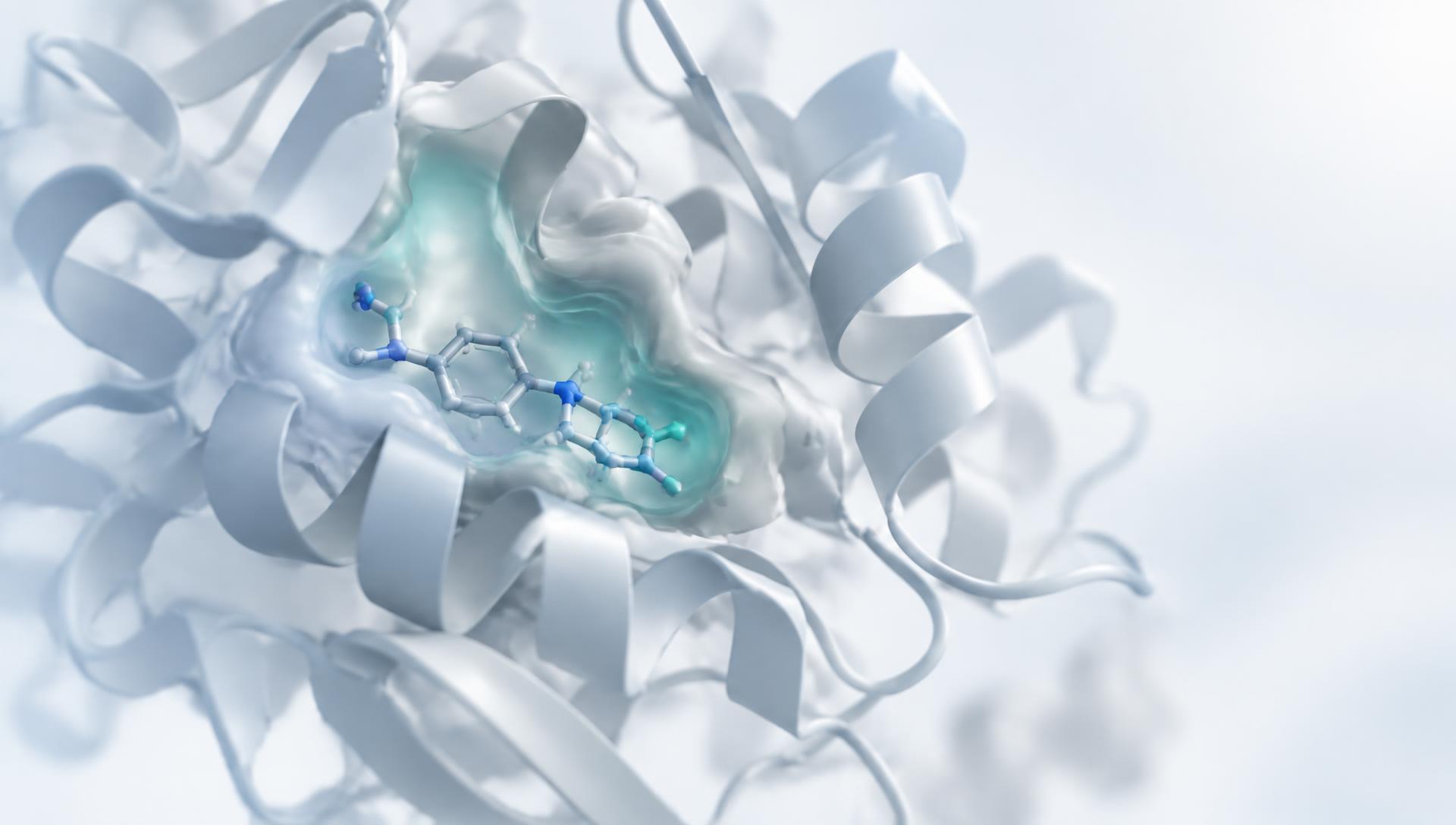
PARG discovery programme
One cancer target.
Twenty testable candidates.
OnPARG turns validated PARG biology, experimental structures and independent molecular models into a diverse shortlist for laboratory testing.
8.9
Target score
5
PARG structures
20
Testable candidates
Pipeline
From one target to twenty testable molecules.
Target gate
Score candidate targets before spending a campaign.
Dossier
Assemble the biology, competition and unmet need.
Structure
Choose experimental states, not one convenient model.
Pockets
Rank every exploitable site, not just the obvious one.
Design
Independent generative campaigns for chemical breadth.
Filter
Remove what nobody could make or develop.
Dock
Keep multiple plausible poses per molecule.
Verify
Re-test survivors with a second, independent model.
Selectivity
Compare the target against its closest relatives.
Diversity
Cluster, then pick one representative per series.
Shortlist
Twenty candidates with full computational provenance.
Lab
Experimental testing with Adaptyv Bio, then recalibrate.
The target
Why PARG, and nothing else.
The platform compared PARG against a field of oncology targets on the same scale. It scored highest on risk-adjusted opportunity, and the campaign stays fixed there.
Decision: proceed. Full scorecard inside the platform.
Synthetic lethality
Blocking PAR turnover is selectively lethal in tumours carrying replication stress and defective homologous recombination.
Resistance opening
Tumours that lose PARG to escape PARP inhibitors become hypersensitive to further PARG inhibition.
No approved drug
There is no approved PARG inhibitor. Published chemical matter is narrow and dominated by one chemotype.
Clinical precedent
FORX-428 has reached Phase 1 in advanced solid tumours, which gives the programme a benchmark and a path.
Platform
Four engines, running together.
Find
Which target deserves the campaign. Genomic and variant reasoning, human evidence, druggability, competition.
Design
What could attack it. Parallel generative campaigns around the chosen pocket, filtered for real chemistry.
Verify
Which molecules independent models agree on. Pose generation, affinity prediction, selectivity, developability.
Learn
What the bench taught us. Measured results recalibrate the models and steer the next generation.
Evidence
Everything traces back to a source.
Structures, assays, compounds and clinical programmes are drawn from public scientific records, and every candidate carries the models that supported it.
- Structures
PDB 6OAK, 6O9X, 6O9Y, 7KFP, 4B1G
- Chemistry
ChEMBL target CHEMBL1795143
- Affinity
BindingDB affinity records
- Target evidence
Open Targets Platform
- Known inhibitors
PubChem PDD compound series
- Datasets
ProteomeXchange, Zenodo, BioStudies
About
A discovery engine, honestly described.
OnPARG uses generative and structural models to design and prioritise novel small molecules against a validated cancer target, for experimental testing.
It does not claim a finished medicine. The campaign ends with twenty diverse candidates and the package a laboratory needs to test them.
Open the platform